One of the most annoying Android problems is seeing the “Storage full” notification when you are trying to take a photo, install an app, or download an important file. I have experienced this myself, and in many cases, the problem is not that the phone suddenly became useless. Usually, storage has slowly filled up with photos, videos, downloads, applications, cached files, and other data that we often forget about.
The good thing is that you can usually free up a significant amount of space without deleting important personal files. In this guide, I will explain how I personally approach an Android phone with full storage and the safest ways to recover space.
Why Does Android Phone Storage Become Full?
Android phone storage can fill up surprisingly quickly. Photos and videos are usually the biggest reason, especially if you regularly record high quality videos. Social media applications can also store large amounts of temporary and downloaded content.
Applications themselves can take considerable space, while games may require several gigabytes. Downloads, screenshots, documents, offline videos, music, and messaging media can add even more.
Another reason is that some applications build up cache over time. Cache is temporary data designed to make applications work faster, but it can become quite large.
The first step I recommend is finding out exactly what is using your storage instead of randomly deleting files.
Check What Is Using Your Storage
Before deleting anything, open Settings and look for the Storage section. The exact name and location can vary depending on your Android phone.
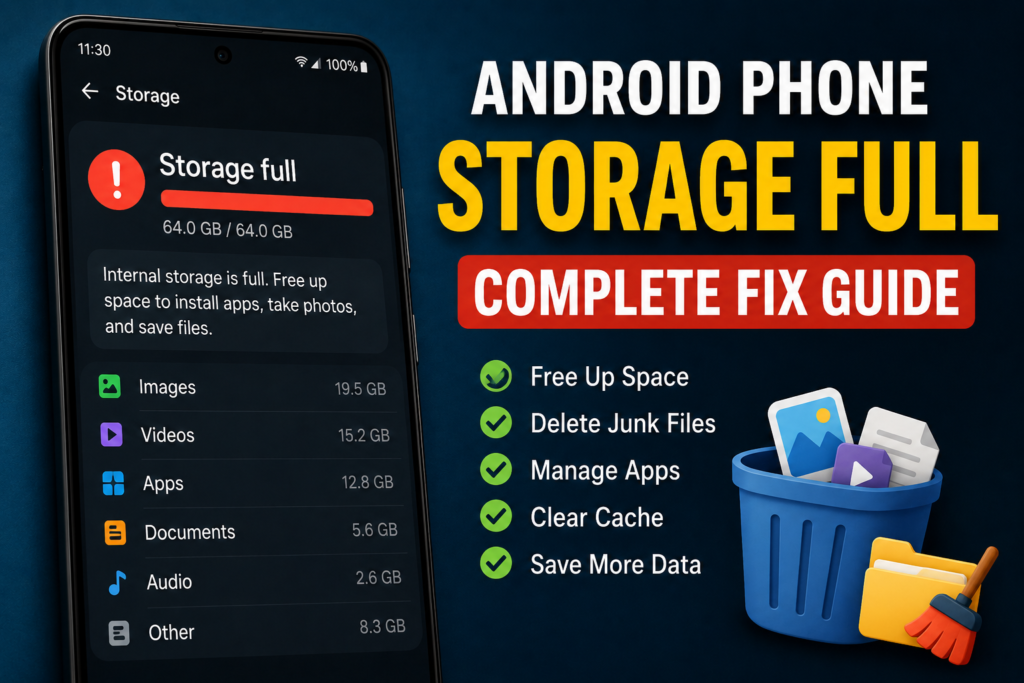
You should see categories such as Apps, Images, Videos, Audio, Documents, Downloads, and System.
Take a moment to look at the largest category. If videos are using most of your storage, deleting unnecessary videos or moving them elsewhere will make the biggest difference.
If applications are taking most of the space, review your installed apps and remove the ones you no longer use.
This simple check can prevent you from wasting time deleting small files when one category is responsible for most of the problem.
Delete Unnecessary Videos
In my experience, videos are often the fastest way to recover storage.
Open your gallery and look for old recordings, duplicate videos, downloaded clips, and videos that you no longer need.
Pay special attention to long videos because a single high quality recording can consume hundreds of megabytes or more.
Before deleting personal videos, make sure they are backed up if you want to keep them. Once you are confident that important memories are safe, remove unnecessary files.
Remember to check the Recently Deleted or Trash folder afterward. Deleted files may continue occupying storage until the trash is permanently cleared.
Remove Duplicate Photos
Many people have hundreds or thousands of photos stored on their phones, including duplicate images.
You may have taken several similar photos of the same scene or received the same image through different messaging applications.
Review your gallery and remove obvious duplicates and blurry pictures. If your phone provides a duplicate detection or storage cleanup feature, you can use it to identify unnecessary files.
I prefer reviewing important photos before deleting them because automatic cleanup tools are convenient but should still be used carefully.
Clean the Downloads Folder
The Downloads folder is another place I recommend checking.
Over time, Android phones can collect PDFs, documents, images, installation files, screenshots, and other files that were downloaded once and never used again.
Open your file manager and locate the Downloads folder. Sort the files by size if your file manager supports that option.
Large files that you no longer need can be deleted first. This can quickly recover useful storage.
Be careful with important documents, tickets, certificates, or work files. Do not delete something simply because you do not recognize the filename.
Uninstall Apps You No Longer Use
Take a look at your installed applications. You may discover apps that you downloaded months ago but rarely open.
Uninstalling unused apps is one of the easiest ways to free storage.
Games are especially worth checking because some can take several gigabytes after updates and additional downloads.
I usually ask myself whether I have used an app recently and whether I genuinely need it. If the answer is no, removing it can make sense.
You can always reinstall an app later if you need it again, provided it is still available and compatible with your phone.
Clear App Cache
Clearing cache can sometimes recover storage without removing your personal information.
Open Settings, go to Apps, select an application, and look for its Storage section. You may see an option to clear the cache.
Social media, browsers, streaming services, and other frequently used applications can accumulate substantial temporary data.
However, I would not recommend clearing every application’s data without understanding the difference between cache and app data.
Clearing app data can sign you out or remove locally stored information. Cache is generally the safer option when your goal is simply to remove temporary files.
Manage WhatsApp and Messaging Media
Messaging applications can quietly consume a huge amount of storage.
Photos, videos, voice messages, documents, stickers, and forwarded files can accumulate over months or years.
Open the storage management section inside your messaging application and review large files. Remove unnecessary videos, duplicate media, and files from chats that you no longer need.
This is often one of the most effective ways to free space, especially if you participate in large group chats.
Before deleting anything, check whether important family photos, documents, or other personal files need to be saved somewhere else.
Check Offline Downloads
Streaming applications can save content for offline viewing, and this content can occupy a lot of storage.
Check your music, video, podcast, and other entertainment applications for downloaded content.
If you downloaded several movies, playlists, or podcasts for a previous trip and no longer need them offline, remove them.
You can always download them again later when you have a reliable internet connection.
Move Photos and Videos to Cloud Storage
If you have many important photos and videos, deleting everything is not the only solution.
You can back up personal media to a trusted cloud storage service and then remove local copies that you no longer need.
This approach is particularly useful for people who have limited internal storage.
Before deleting local files, confirm that the backup has completed successfully. I always recommend checking a few important photos from the cloud service before removing their phone copies.
Transfer Files to a Computer
Another simple solution is transferring large files to a computer or another trusted storage device.
Connect your Android phone to your computer and copy important photos, videos, documents, and other files.
After confirming that the files transferred correctly, you can remove unnecessary copies from your phone.
This gives you more control over your personal data and can be useful when you have a large collection of videos.
Check Large Files
Your file manager may provide an option to find large files.
Look for files that are taking hundreds of megabytes or several gigabytes. Large videos, compressed archives, old installation files, and offline downloads are worth checking.
Do not delete system files simply because they appear large. If you are unsure about a file, leave it alone until you understand what it does.
The goal is to remove unnecessary personal and temporary files, not important Android system components.
Use Android Storage Cleanup Tools
Many Android phones include built in storage management tools that can recommend unnecessary files.
Depending on your phone, these tools may identify temporary files, unused apps, duplicate files, large videos, or other items.
These recommendations can make the cleanup process easier.
Still, I recommend reviewing the suggested files before deleting them. Automatic cleanup is helpful, but personal files should always be handled carefully.
Restart Your Phone After Cleaning
Once you have removed unnecessary files, restart your Android phone.
A restart allows the system to refresh its storage information and close background processes.
After restarting, open Settings and check the Storage section again.
You should see how much free space is now available. If you only recovered a small amount, go back and look at the largest storage categories again.
Keep Some Free Storage Available
I do not recommend using every last bit of your phone’s storage.
Android needs available space for temporary files, application updates, system operations, and other tasks. When storage becomes extremely low, you may notice slower performance and problems installing applications or downloading files.
Try to maintain a reasonable amount of free space instead of waiting until the phone displays a storage warning.
A little regular maintenance can prevent a much bigger cleanup later.
Avoid Random Cleaner Applications
When Android storage is full, you may see advertisements for applications promising to clean everything with one tap.
I recommend being selective.
You do not necessarily need a third party cleaner to manage your storage. Android already provides storage tools, and your file manager can help you identify unnecessary files.
Installing another application simply to clean storage can sometimes create another application that consumes storage.
If you use a cleaning tool, make sure it comes from a trustworthy source and understand what it is deleting.
What If Android Storage Is Still Full?
Sometimes you delete files but the available storage does not increase as expected.
First, check the Trash or Recently Deleted folders in your gallery and file manager. Deleted files may still be stored there temporarily.
Then restart the phone and check the storage information again.
If the System or Other category appears unusually large, the issue may require more detailed troubleshooting. Do not manually delete system files unless you know exactly what they are.
If storage remains incorrectly reported after repeated cleanup and restarting, consider contacting the phone manufacturer’s support service.
Final Thoughts
An Android phone with full storage can be frustrating, but the solution is usually easier than it first appears. I recommend starting by checking exactly what is consuming your storage and then dealing with the largest categories first.
For most people, photos, videos, unused applications, downloads, messaging media, and cached files are the biggest targets.
Instead of deleting everything at once, I prefer going through files carefully and protecting anything important. Backing up personal photos and documents before deleting them is especially important.
Once you recover enough space, try to keep some storage available in the future. Regularly reviewing your downloads, removing unused applications, cleaning unnecessary media, and managing large files can prevent the same problem from returning.
With these simple steps, you can usually free a significant amount of Android storage and get your phone back to normal without deleting important personal data or performing a factory reset.